LaneList Monthly Lane Signals: June 2026 Search Insights
In short: June 2026 LaneList search insights show which transport lanes shippers were searching, from Belgium to Estonia to Poland to Germany, and why lane-based carrier sourcing matters for European freight.
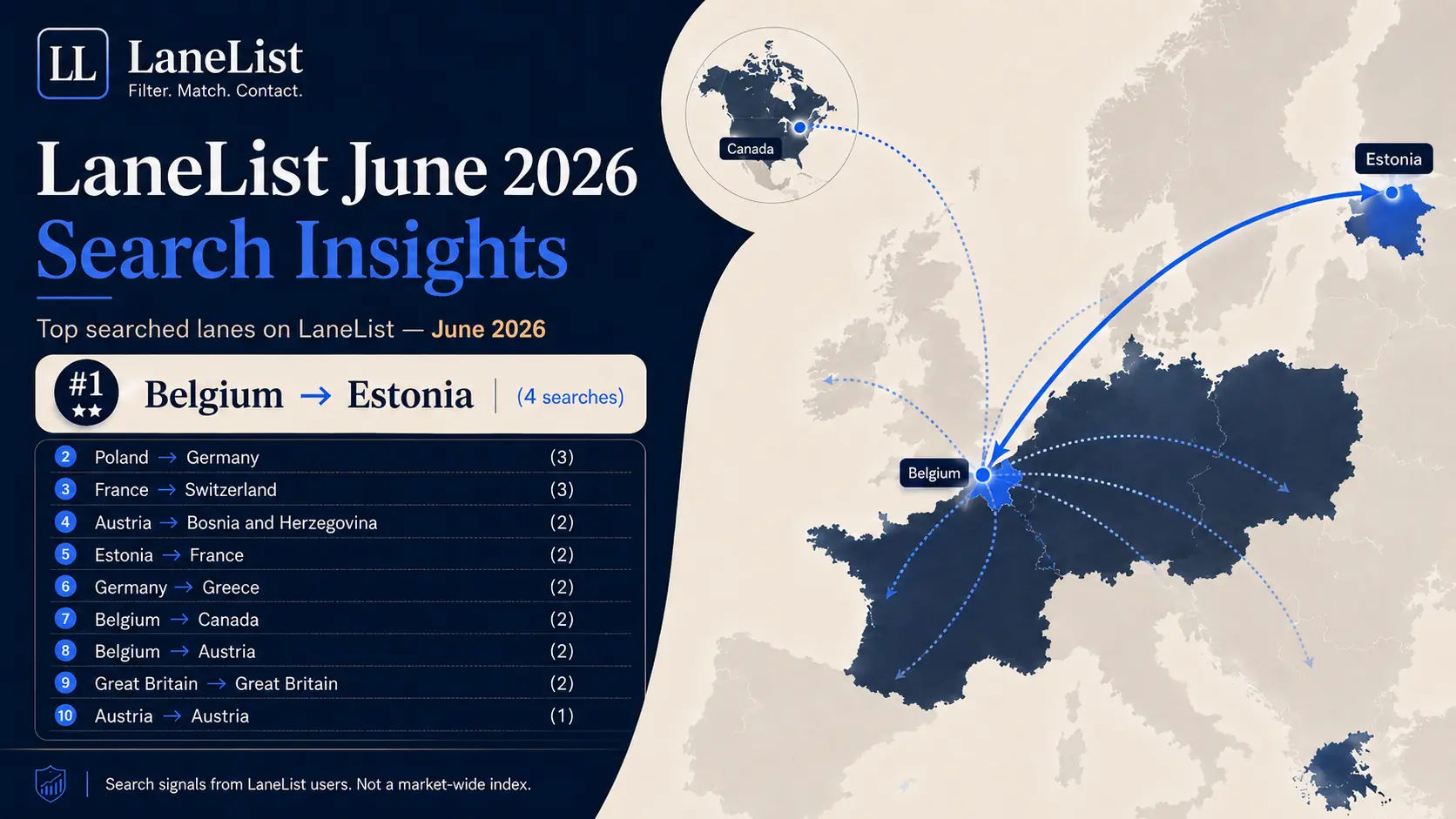
LaneList Monthly Lane Signals: June 2026 Search Insights
Updated: 2 July 2026. Transport demand does not always appear where we expect it. In June 2026, LaneList users searched for European carriers across classic freight corridors, specific cross-border transport lanes, domestic routes and a few less obvious international connections.
This data is not a full market index. It is a practical snapshot of what shippers, importers, freight forwarders and logistics teams were actively trying to find through LaneList during the month.
The signal is simple but useful: when users search by origin → destination, they show where carrier sourcing is needed. That is the same logic behind the LaneList European carrier search experience: filter by transport type, origin and destination, then contact relevant carriers directly.
The clearest signal in June: Belgium → Estonia
The most searched lane on LaneList in June was Belgium → Estonia, with 4 searches.
At first glance, this may not be the corridor most people mention when talking about European freight. Industry conversations often focus on high-volume lanes such as France–Germany, Poland–Germany, Benelux–France or Italy–Spain.
But real transport needs are not always built around the most obvious routes. A company may need to move goods from Belgium to the Baltics. A carrier may already cover Northern or Eastern Europe but remain difficult to find online. A shipper may know the origin and destination, but not know which transport companies actually operate between the two.
That is exactly where a lane-based carrier directory becomes useful.
Top 10 searched lanes on LaneList in June 2026
Here are the top 10 transport lanes searched on LaneList during June 2026:
- Belgium → Estonia — 4 searches
- Poland → Germany — 3 searches
- France → Switzerland — 3 searches
- Austria → Bosnia and Herzegovina — 2 searches
- Estonia → France — 2 searches
- Germany → Greece — 2 searches
- Belgium → Canada — 2 searches
- Belgium → Austria — 2 searches
- Great Britain → Great Britain — 2 searches
- Austria → Austria — 1 search
What the June searches tell us
The June results show a mix of predictable and less predictable demand. Some lanes are part of familiar European freight flows. Others are more specific, more regional or more operationally complex.
That matters because freight decisions are rarely made in theory. They are made around a practical question: which European carriers can actually operate this lane, with this transport type, at this moment?
This is also why LaneList keeps promoting lane-based carrier sourcing. Transport is not only about collecting company names. It is about matching the right carrier to the right origin-destination pair. That idea is explored further in Why European Freight Should Be Organized by Lanes, Not Companies.
Specific lanes deserve more visibility
Lanes like Belgium → Estonia, Austria → Bosnia and Herzegovina and Estonia → France show how specific freight demand can be.
These are the kinds of routes where a simple online search is not always enough. Shippers often need clearer answers:
- Which carriers actually operate on this lane?
- Do they handle regular freight or only certain types of goods?
- Can they manage cross-border requirements?
- Are they active, reachable and relevant?
For less obvious transport lanes, visibility becomes even more important. If a carrier serves a specific corridor but does not make that information easy to find, the opportunity can be missed.
Classic European corridors are still part of the picture
Not every June search was niche. Some results were more expected.
Poland → Germany remains a strong logistics corridor, supported by manufacturing, distribution, e-commerce, industrial goods and road freight flows. France → Switzerland also represents a common cross-border need, often with additional customs, administrative or compliance considerations.
These searches show that LaneList is not only useful for unusual lanes. It also helps users identify European carriers on established commercial corridors where demand is regular but carrier selection still matters.
Cross-border complexity creates search demand
Several June lanes involve routes where transport may require more planning:
- France → Switzerland
- Austria → Bosnia and Herzegovina
- Germany → Greece
- Belgium → Canada
- Estonia → France
Depending on the lane, shippers may need to consider customs, documentation, longer distances, multimodal options, fuel costs, insurance, port connections or fewer obvious carrier choices.
When a route becomes more complex, a generic list of transport companies is not enough. Users need lane-fit options. This clarity gap is also described in Too Many Carriers, Not Enough Clarity: A European Freight Reality.
Domestic transport is still part of the picture
The June results also included Great Britain → Great Britain and Austria → Austria.
That matters because not every logistics need is international. Some users are looking for carriers within a single country, either for local distribution, national freight, domestic transport planning or regular regional flows.
For carriers, this is a reminder that national coverage should be clearly listed. For shippers, it shows that LaneList can support both domestic and cross-border carrier searches.
What this means for carriers
If you operate on one of these lanes, or on similar routes, your visibility matters.
Shippers are not always searching by company name. Very often, they start with the route: origin → destination.
That means a carrier can miss opportunities simply because its lanes are not easy to find. This is especially true in markets where logistics decisions still depend heavily on personal networks, as explained in Why “Who Do You Know?” Still Drives European Freight Decisions.
Being listed on LaneList helps carriers show where they operate, which transport types they offer and which countries they connect. It gives shippers a faster way to understand whether a carrier is relevant for a specific transport need.
If your company serves European transport lanes and wants to be easier to find, you can Add your company on LaneList.
What this means for shippers and importers
For shippers and importers, the June data is a reminder that carrier sourcing should start with the lane.
Instead of asking only “Which transport company should I contact?”, a more practical question is: “Which carriers actually operate between my origin and destination?”
This approach is especially useful for less common routes, cross-border shipments and lanes where available options may not be immediately obvious.
It also supports better verification habits. A verified carrier does not remove the need for normal checks, but it helps users build a cleaner shortlist. For more practical guidance, read Finding Reliable Carriers in Europe: Essential Best Practices for Logistics Agents.
Why LaneList tracks lane searches
LaneList is built around a simple idea: transport is not only about company names. It is about routes.
A carrier may be excellent, but if it does not serve your lane, it is not the right match. Another carrier may be smaller or less visible online, but perfectly relevant for a specific corridor.
By tracking lane searches, LaneList can better understand what users are trying to find and help make European transport connections easier to identify.
Final takeaway: real demand is lane-based
The June 2026 searches show something important: real transport demand is specific, practical and lane-based.
Some searches are predictable. Others are more niche. But they all point to the same need: shippers want to find the right carrier for the right route.
And carriers need to be visible where their lanes are being searched.
Need to find carriers for a specific European lane? Start with the LaneList carrier search. Filter by transport type, origin and destination, discover relevant European carriers and contact them directly. For questions, partnerships or verification, visit the Contact page.
Filter. Match. Contact. Better lane visibility helps shippers move faster and helps carriers appear where demand is already being searched.