Why Two Carriers Quote Different Prices for the Same European Freight Lane
In short: Why prices differ on the same European freight route: empty kilometres, backhauls, fuel, tolls and smarter carrier sourcing.
Why Two Carriers Quote Different Prices for the Same European Freight Lane
Published: 12 October 2026.
In short: Two carriers can quote very different prices for the same European road freight movement because they do not start from the same position, have the same return-load opportunities or operate under identical cost structures. Empty kilometres, backhauls, tolls, fuel costs, equipment, timing and service conditions all matter. Understanding these variables helps shippers compare genuinely equivalent offers.
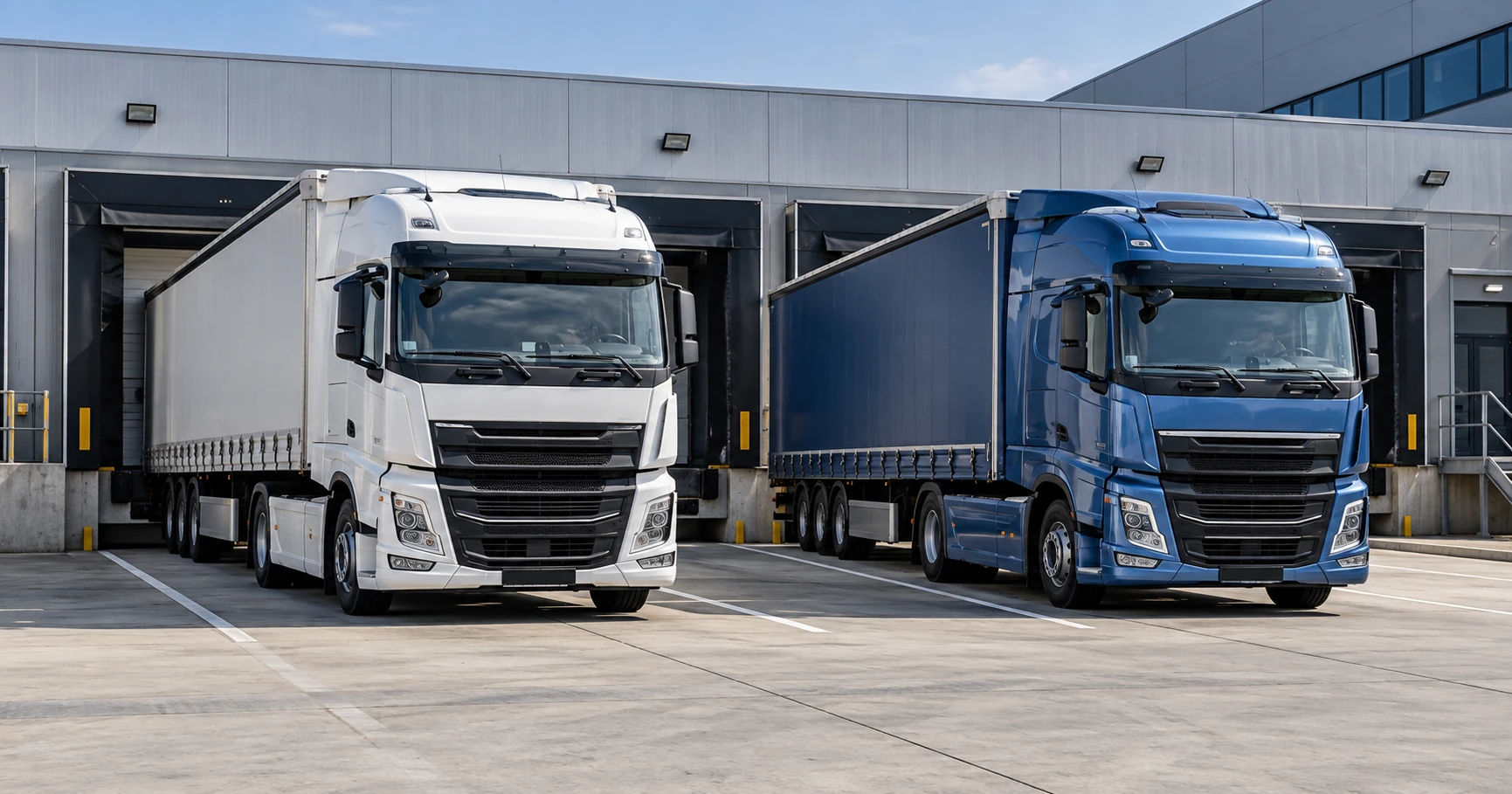
Two trucks. One collection address in Lyon. One delivery in Frankfurt. The same palletised cargo.
Carrier A quotes €1,250. Carrier B quotes €1,780. A difference of €530 for what appears to be precisely the same service.
It is tempting to conclude that one company is overcharging. But Carrier A may have a truck unloading 20 kilometres from the collection point, while Carrier B must reposition a vehicle 250 kilometres before loading. Carrier A may also have its next customer near Frankfurt. Carrier B may have no confirmed onward work.
The real question is not simply “Which carrier is cheaper?” It is “Why does this journey fit one carrier's network better than another's?”
The quotations and vehicle positions throughout this article are illustrative, not live market prices.
1. Freight pricing is more than distance multiplied by a rate
Distance is an important input, but a European freight quotation reflects the entire vehicle movement, not just the loaded kilometres visible to the shipper. A carrier must also recover vehicle ownership costs, driver time, fuel, maintenance, insurance and the commercial risk of allocating capacity to the job.
For a standard full truckload (FTL), the carrier will usually consider:
- Empty positioning before collection and after delivery.
- Fuel, motorway tolls and road-user charges across the actual itinerary.
- Driver availability, working time, rest periods and overnight expenses.
- The size, weight, handling requirements and equipment needed for the cargo.
- Loading and unloading appointments, waiting time and possible delays.
- Whether the vehicle can earn revenue again soon after delivery.
- Quote validity, payment terms and any agreed fuel-adjustment mechanism.
This explains why a single universal euro-per-kilometre rate cannot describe every European lane. Even where two trucks follow the same motorway, their economic starting points may be completely different.
2. Empty kilometres: the cost that rarely appears on the quotation
Empty running means moving a truck without revenue-generating cargo. It can happen on the way to collection, after a delivery, or between two customers. Although the vehicle is empty, it still burns fuel, occupies a driver and accumulates operating costs.
Picture two hauliers responding to the same Lyon–Frankfurt request:
- Carrier A: a suitable truck is 20 km from pickup; onward work is already planned near Frankfurt.
- Carrier B: the nearest suitable truck is 250 km away; the next load after Frankfurt is uncertain.
Assume a truck consumes 30 litres per 100 km and the carrier buys diesel at €1.70 per litre. An extra 250 empty kilometres would consume 75 litres, or €127.50 of fuel alone. Driver time, tolls, tyres, maintenance and the opportunity cost of the vehicle are still missing from that calculation.
Actual fuel consumption and purchase prices vary. The example is a way to illustrate the mechanism, not a recommended trucking tariff.
This is also why the carrier's registered address can be less useful than its actual vehicle position and network. A company based farther away may still offer a better quotation if one of its trucks is already working near the loading site.
3. The backhaul advantage — and why direction matters
A backhaul is a revenue-generating load that fits a vehicle's return journey or next operating leg. It can make an otherwise costly repositioning movement commercially worthwhile.
Imagine a haulier carrying goods regularly from Germany into Spain. If it has limited contracted business in the opposite direction, a suitable Spain-to-Germany shipment can help the vehicle return toward its main network while earning revenue.
That does not mean all backhauls should be cheap. The operator still has costs and must protect a sustainable margin. But a load that is awkward for one fleet may be an excellent fit for another.
Direction also matters. Germany → Spain and Spain → Germany are not automatically the same market. Demand, seasonality, industrial production, equipment and available vehicles can differ on either side of the corridor. The same is true for Italy–France, Netherlands–Poland and many other European country pairs.
This is one reason we advocate organising European freight by operating lanes rather than broad company lists. Origin and destination must be considered together, including the direction of movement.
4. Transport type changes the price comparison
A quotation is only comparable if both companies are proposing an equivalent service. European carriers operate very different networks and types of equipment.
Full truckload (FTL)
A dedicated truck may be appropriate for a large shipment, direct delivery, limited handling or a strict time window. The buyer is paying for the deployment of that vehicle, even if it is not completely full.
Less-than-truckload (LTL) and groupage
A groupage operator combines several consignments through a distribution network. This can be more economical for smaller shipments, but consolidation, terminals, handling and fixed departure schedules influence the price and lead time.
Specialist equipment
Refrigerated transport, tankers, container haulage, flatbeds and low-loaders have different operating costs. Temperature control, cleaning requirements, securing equipment, relevant certifications and cargo compatibility can materially affect a quotation.
A low price for the wrong equipment is not a saving. Before comparing carriers, specify the shipment profile and transport type precisely.
5. Country-specific tolls and operating costs complicate European quotes
Cross-border European road freight passes through different infrastructure-charging systems, road networks and operating environments. A truck may face distance-based charges, tolled motorways, tunnel costs or other applicable road-user fees.
Some charges depend on vehicle weight, axles, emissions characteristics or other classification criteria. Two fleets may therefore face different expenses on the same broad corridor. Their route choices can differ too: one itinerary may cost more in tolls but allow a more reliable delivery time.
Drivers' employment costs, fleet financing, vehicle efficiency and maintenance practices also differ among operators. International road transport remains subject to applicable driving/rest-time rules, cabotage restrictions and other European requirements; an attractive quote does not remove the need for lawful operations.
A practical example: a France-to-Italy quotation involving an Alpine crossing may include different toll and routing assumptions from another quote for the same two countries. Ask what itinerary and charges are included rather than assuming the headline price covers the same things.
6. Fuel costs matter, but carriers buy diesel differently
Fuel is a major operating cost in long-haul road freight. Yet two carriers can experience the same increase in market diesel prices differently.
One may have fleet fuel-card agreements or negotiated purchasing conditions. Another may refuel in different countries. Their trucks may consume different quantities per 100 kilometres. Under a long-term contract, a carrier may use an indexed fuel surcharge, whereas an individual spot quotation may reflect current capacity conditions more directly.
For the freight buyer, this creates two important distinctions:
- Base rate versus all-in price: clarify whether fuel supplements, road tolls and other fees are already included.
- Contract rate versus spot rate: a formula updated monthly is not the same as a last-minute offer for one available truck.
This is not a reason to assume the most expensive quotation is unfair. It is a reason to ask how the total price is constructed, particularly on recurring international lanes.
7. Timing, waiting and loading conditions have a real cost
A shipper requesting loading tomorrow at 08:00 may receive a different price from one able to offer a flexible three-day collection window. Flexibility makes it easier for carriers to combine jobs and position vehicles efficiently.
Conversely, strict loading slots, unpredictable warehouse queues, limited delivery hours and changes to appointments can reduce fleet utilisation. A truck delayed for several hours at unloading may miss its next booking.
For recurring shipments, buyers can improve the commercial conditions by providing realistic forecasts, accurate cargo details and predictable appointment processes. Price negotiation matters, but making freight easier to operate can be just as valuable as asking for a lower price.
8. Lyon–Frankfurt: how to evaluate two quotations fairly
Return to the illustrative example. Carrier A offers €1,250 and Carrier B €1,780. Carrier A is positioned closer to loading and has onward work; Carrier B faces a longer empty movement and an uncertain return.
The difference may reflect network economics rather than excessive margins. But the buyer still needs to compare like with like. Before awarding the shipment, ask:
- Do both offers use the correct vehicle and include the same cargo-handling requirements?
- Are fuel supplements, tolls and waiting-time allowances included?
- Do the proposed collection and delivery windows match the request?
- How long is each quotation valid, and what triggers additional charges?
- Is the movement operated directly or subcontracted, and who is responsible for it?
- Have the appropriate authorisations, liability conditions and insurance arrangements been checked?
A low quotation that excludes essential services can end up costing more than the complete alternative. For a fuller qualification process, read these practical steps for finding reliable European carriers.
9. Better carrier sourcing starts with the actual lane
Searching for “transport companies in Germany” when shipping from Lyon to Frankfurt can return many irrelevant providers: domestic distributors, warehouse businesses or carriers that do not offer the required equipment or direction.
A better starting point is transport type → origin → destination. For example: standard road freight, France → Germany. Only then does it make sense to ask which shortlisted operators can serve the precise pickup and delivery addresses, dates and cargo requirements.
This is the reasoning behind the problem of having too many carrier names but too little practical clarity.
LaneList is designed for this discovery stage. Its European carrier search lets users filter by transport type, origin and destination, review carrier profiles, use the available verification signal and contact relevant operators directly. It does not publish guaranteed live truck capacity or calculate binding freight rates; availability, prices and contractual details must be confirmed with each carrier.
For the practical workflow, see how LaneList works.
10. What this means for both shippers and carriers
For importers, exporters, traders and freight forwarders, the lesson is to compare properly defined services from carriers with a real connection to the requested corridor. Knowing why a quotation differs puts buyers in a stronger position to negotiate and to evaluate service risk.
For small and medium-sized transport operators, the implication is equally useful. A company does not need Europe's largest fleet to be highly competitive on selected lanes. Regular customers, strong return-load patterns, specialist vehicles and local operational knowledge can give it an advantage.
But that advantage is difficult to commercialise if potential customers cannot discover its lane coverage. Clearly presenting countries served and transport types helps the right buyers find the right business.
Conclusion: compare the network, not only the number
The cheapest road freight quotation is not automatically the best offer, and the highest quotation is not automatically unreasonable. Truck positioning, empty kilometres, backhauls, diesel purchasing, tolls, equipment, scheduling and contractual scope all contribute to the final price.
Before comparing prices, make sure you are comparing the same service — and carriers that genuinely fit the same transport lane.
Need a carrier for a specific European origin–destination pair? Search European carriers on LaneList, select the transport type and countries, then contact suitable providers directly.
LaneList — Filter. Match. Contact.
Editorial note: Monetary quotations, fuel calculations and vehicle positioning scenarios are illustrative. They are not observed market quotations or guaranteed carrier prices.