The World Cup is not only a sports event. It is a freight challenge.
In short: The World Cup shows how complex logistics really is. From road freight to air, sea, rail and multimodal transport, major events reveal why European freight depends on the right route, cargo and carrier fit.
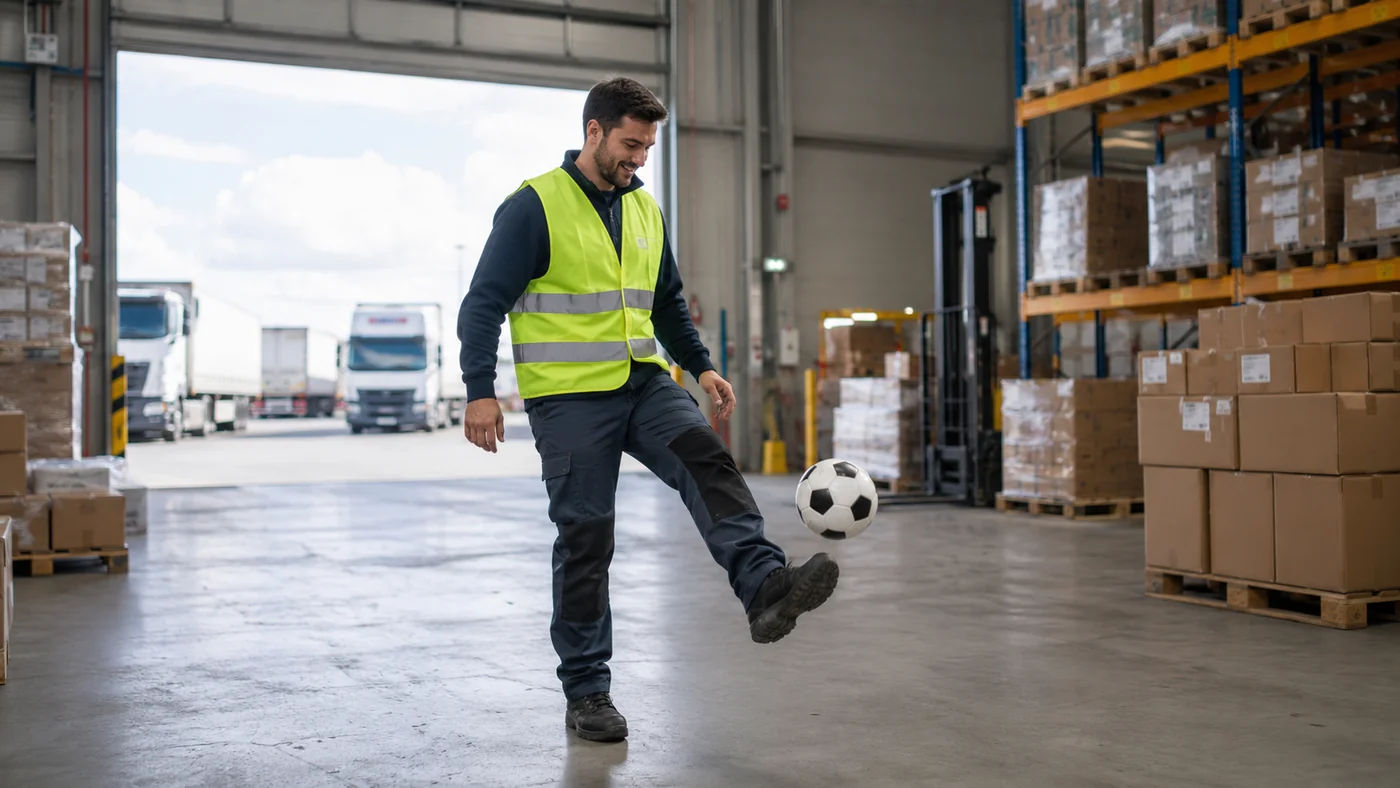
The World Cup is not only a sports event. It is a freight challenge.
Updated: 8 July 2026. When people think about the World Cup, they usually think about football first: the stadiums, the supporters, the national teams, the shirts, the flags and the noise.
But before any of that happens, another match has already started. It is not played on the pitch. It happens in warehouses, ports, airports, distribution centers, customs offices, truck depots and planning rooms.
It is the logistics match.
A World Cup needs far more than players and fans. It needs equipment, food and beverages, broadcast material, merchandise, signage, furniture, temporary structures, uniforms, security material, medical supplies and technical installations.
All of it has to arrive in the right place. Not roughly. Not eventually. On time.
That is why the World Cup is not only a sports event. It is a freight challenge.
A stadium is also a temporary supply chain
A football stadium may look ready from the outside. For a major international event, however, it becomes a temporary supply chain with strict deadlines and very little room for error.
Broadcast teams need cameras, cables, screens, lighting equipment and technical infrastructure. Hospitality teams need food, drinks, furniture, kitchen equipment and service supplies. Retail teams need merchandise, packaging, payment equipment and replenishment stock.
Event teams need signage, barriers, uniforms, accreditation material and installation crews. Security and medical teams need their own equipment too.
Each item has its own supplier, route, deadline and handling requirements. Some goods are planned months in advance. Others move late because quantities, sponsors, match locations or operational details change.
This is where logistics becomes difficult. It is not only about moving goods from one place to another. It is about coordinating many different flows, with different levels of urgency, across different transport modes.
Freight does not move as one big block
From the outside, people often talk about “the logistics” of an event as if it were one single operation. In reality, it is a collection of many smaller transport problems.
Some shipments are urgent and may need air freight. Some are heavy or bulky and may need road freight, containers, rail or sea freight. Some require temperature control. Some need special handling.
Some move as full truckloads. Others move as groupage, LTL or express shipments. Some are delivered directly to the venue. Others go first to a warehouse, a consolidation center or a local distribution hub before being sent to the final site.
That is why freight planning is rarely generic. The right solution depends on the cargo, the timing, the origin, the destination and the transport type.
A shipment of broadcast equipment is not the same as a shipment of drinks. A delivery of temporary structures is not the same as a pallet of merchandise. A refrigerated load is not the same as a flatbed operation. A planned container movement is not the same as an urgent air freight request.
The word “transport” may sound simple. The reality behind it is much more specific.
The route is often the real challenge
In freight, the route matters as much as the cargo. A company may know exactly what it needs to ship, but still struggle to find the right partner for the route.
That is especially true in Europe. European freight is dense, cross-border and fragmented. There are many carriers, many specializations, many regional strengths and many transport corridors. But that does not mean the right provider is always easy to find.
A shipper may need:
- Belgium → Estonia
- France → Switzerland
- Germany → Greece
- Italy → Poland
- Austria → Bosnia and Herzegovina
- Spain → Netherlands
- Czech Republic → France
- Poland → Portugal
These are real transport needs, but they are not always the obvious routes that appear first in a general search.
A carrier may be strong between France and Germany but not operate regularly toward the Baltics. Another may handle refrigerated cargo across Spain and Italy but not offer flatbed transport. A freight forwarder may be useful for air and sea freight but not be the right contact for a direct road movement.
The challenge is not simply finding a transport company. The challenge is finding a transport company that actually operates the lane you need. This is why the idea behind organizing European freight by lanes, not only by company names has become so relevant.
Major events make this easier to see
The World Cup makes freight complexity visible because the deadline is fixed. The match will not wait because a truck is late. The broadcast schedule will not move because equipment is delayed. The fan zone cannot open properly if signage, merchandise or technical material is missing.
The same pressure exists in many business situations, even if they are less public.
- A product launch also has a date.
- A trade fair also has a setup deadline.
- A factory delivery may affect production.
- A construction site may be blocked by one missing shipment.
- A retailer may need stock before a campaign starts.
- A food importer may depend on temperature-controlled transport arriving on time.
- An industrial company may need spare parts quickly to avoid downtime.
Different context, same logistics problem. The freight has to move correctly before the visible part of the operation can succeed.
Road, rail, sea, air and multimodal all have a role
A major event usually depends on several transport modes. So does European trade.
Road freight remains essential because it is flexible. It connects factories, warehouses, ports, airports, shops, venues and customers. It is often the final link, even when goods first move by sea, rail or air.
Rail freight can be useful for structured flows, heavier volumes and longer distances, especially when terminals and schedules match the operation.
Sea freight supports container movements, Ro-Ro flows, international trade and larger planned shipments.
Air freight is usually reserved for urgent, high-value or time-sensitive goods.
Multimodal transport connects these modes and can help when companies need a more balanced solution between cost, capacity and timing.
But choosing the mode is only part of the work. The real operational question is more precise: which provider can handle this transport type, from this origin to this destination, under these constraints?
Why carrier discovery is still harder than it should be
One of the strange things about European freight is that the capacity often exists, but finding it can still be difficult.
Many carriers are highly relevant for specific lanes but are not always easy to discover online. Some are known locally but not internationally. Some specialize in particular routes or cargo types, but that information is not always clear from a general company profile.
Some are present in directories, but the search does not reflect how shippers actually think: origin, destination, transport type, timing and contact.
So companies spend time searching, comparing, asking, emailing and waiting. Sometimes they find a good match. Sometimes they find a company that looks relevant but does not actually serve the route. Sometimes they only discover the right option after several calls.
In a market where fuel costs, driver availability, customs procedures, delivery windows and customer expectations already create pressure, that discovery process should be easier. The problem is close to what many logistics teams face every day: too many carriers, not enough clarity.
What the World Cup teaches European freight
The World Cup is an extreme example, but the lesson is practical: freight works best when the route, the cargo and the provider are aligned.
A shipment is not only “a shipment.” It is a specific movement, with a specific origin, destination, transport mode, timing and risk.
That is why the same carrier will not be the right answer for every operation. A shipper organizing a delivery from France to Switzerland may need a very different partner from one moving goods from Germany to Greece.
A company shipping refrigerated goods may need a different network from one moving machinery or containers. An urgent spare part and a planned retail shipment do not belong to the same logistics conversation.
The better the match, the fewer surprises later.
A more practical way to start the search
This is also where LaneList fits naturally into the conversation.
LaneList is not trying to replace freight relationships, negotiation or operational due diligence. Those still matter. Its role is more practical: helping users start the search from the way freight actually works.
Transport type. Origin. Destination.
Instead of beginning with a long list of company names, a user can look for European carriers based on the lane they need. From there, they can review available options and contact companies directly through the LaneList European carrier search.
It is a simple idea, but it reflects a real problem in the market. In freight, the useful question is often not “Which transport companies exist?” It is: who can help with this route?
The invisible work behind visible events
The best logistics work is often invisible. People remember the match, not the truck. They remember the goal, not the warehouse. They remember the atmosphere, not the customs documents, delivery slots, loading plans or route coordination.
But without that invisible work, the visible event becomes fragile.
That is true for the World Cup. It is also true for European trade every day.
Behind every shipment, there is a route. Behind every route, there is a transport decision. Behind every good transport decision, there is usually one simple thing: a better match between the need and the provider.
The World Cup reminds us of that at a global scale. European freight proves it every day.
Need to explore European freight lanes? Start with the route, the transport type and the real operating fit. The rest of the decision becomes clearer from there.