How AI Is Changing European Logistics: Which Jobs Will Change, Which Will Remain and What Comes Next
In short: AI is reshaping European logistics by automating repetitive freight work while increasing the value of carrier knowledge, verification, exception management and human judgement.
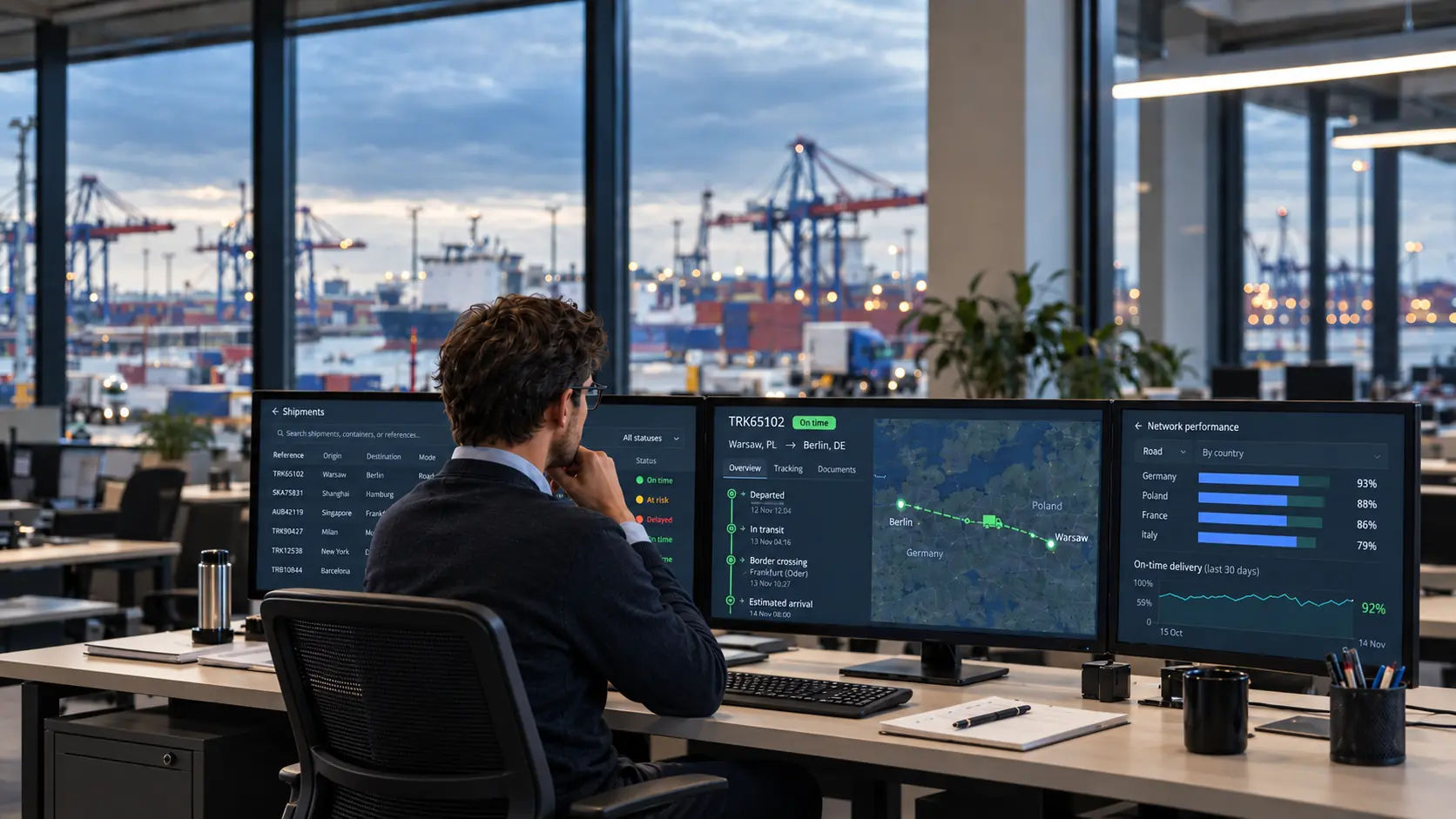
How AI Is Changing European Logistics: Which Jobs Will Change, Which Will Remain and What Comes Next
Updated: 5 October 2026.
In short: AI is unlikely to eliminate freight forwarders, import/export agents or logistics professionals. But it is already reducing the amount of manual work required to manage shipments. In European freight, repetitive administration is becoming easier to automate while carrier knowledge, exception management, trade compliance, negotiation and good transport data are becoming more valuable.
Artificial intelligence is everywhere in logistics conversations right now.
Some people expect almost fully autonomous supply chains. Others dismiss much of it as hype.
The truth is less dramatic, but probably more important.
AI is unlikely to make European logistics professionals disappear overnight. What it is doing is changing what humans actually need to do to move freight.
A shipment that previously required someone to read an email, copy information into a TMS, request several rates, update an Excel file, prepare documents, answer status requests and chase a carrier can increasingly be supported by software at almost every step.
That does not necessarily remove the shipment from the forwarder. It removes pieces of work around the shipment.
And that distinction matters enormously for freight forwarders, transport planners, import/export teams, shippers and European carriers.
The question is therefore no longer simply: “Will AI replace logistics jobs?”
A more useful question is: “Which parts of logistics work will still require a person once machines can handle much of the administration?”
For European freight, the answer tells us a lot about what the next few years could look like.
AI is moving from answering questions to performing work
The first wave of generative AI was easy to understand: ask a question, get an answer; write an email; summarise a document; translate a message; extract information from a PDF.
The next phase is different.
DHL’s 2026 Logistics Trend Radar highlights Agentic AI as one of the technologies expected to have a major impact on logistics. Instead of only producing information, these systems can increasingly work toward a defined objective, coordinate several steps and interact with business systems.
In practical logistics terms, a customer could send a transport request and an AI system could identify:
- origin and destination,
- equipment type,
- weight and commodity,
- loading date and delivery requirement,
- special transport constraints.
It can then potentially:
- search available transport options,
- retrieve contracted rates,
- compare previous carrier performance,
- prepare quotation options,
- flag missing information,
- create a shipment record,
- monitor milestones and identify possible delays,
- prepare customer communication.
None of those tasks is revolutionary on its own. What is revolutionary is connecting them.
That is why the important development in logistics is not simply “ChatGPT for freight”. It is the gradual automation of entire workflows.
The jobs most exposed are not necessarily the jobs people expect
AI discussions often jump immediately to drivers and warehouse robots. Yet some of the first significant employment changes may happen behind a computer screen.
Consider how much freight administration still consists of moving information from one place to another: an employee receives information in an email, copies it into a transport system, retrieves another piece of information from a portal, updates a customer, saves a document, checks an invoice against an order and repeats the process.
Those tasks are highly compatible with automation.
Roles and tasks facing the strongest pressure
The most exposed activities include:
- manual shipment data entry,
- repetitive track-and-trace,
- basic document extraction,
- standard status communication,
- straightforward rate retrieval,
- invoice matching,
- POD processing,
- repetitive quotation preparation,
- routine customer-service requests,
- basic reporting.
That does not mean every employee performing those tasks will disappear. It does mean that a company may eventually need fewer people to process the same number of shipments.
One operator supported by good systems could manage considerably more freight than an operator relying on email, Excel and manual updates.
That is where the real employment impact begins.
Will freight forwarders disappear?
Very unlikely. But the definition of a freight forwarder may change considerably.
Imagine a normal European transport request: 12 pallets, Lyon to Manchester, collection Thursday, delivery Monday.
A traditional process might involve checking several existing contacts, sending emails, waiting for prices, comparing answers, negotiating, updating an internal system and preparing a quotation.
More of that process can now be automated.
But then something happens: the truck breaks down near Calais, the ferry is cancelled, the customer changes the delivery appointment, the carrier asks for additional waiting costs, a document is incorrect, a customs problem appears, the receiver refuses the goods, or the planned carrier cancels collection at 16:30.
Now the problem is no longer data processing. It is judgement.
Someone must understand the commercial context, evaluate alternatives, negotiate, communicate and decide what risk is acceptable.
That is freight forwarding.
And anyone who has worked in logistics knows something important: exceptions are not exceptional in logistics. They are part of the job.
This is why the forwarder’s role is more likely to move from shipment administrator toward transport orchestrator and exception manager than disappear completely.
Import/export jobs may change even faster
Import/export departments contain many activities that AI systems can assist with particularly well because international trade generates enormous amounts of documentation.
Commercial invoices, packing lists, certificates, transport documents, purchase orders, commodity descriptions, customs information, Incoterms, country-of-origin information, delivery instructions and invoices can all be extracted, classified, compared and summarised.
Over time, fewer employees may need to spend their day manually transferring that information between systems.
But this does not make international-trade knowledge irrelevant. Quite the opposite.
European companies operate in an environment of tariffs, sanctions, export controls, sustainability requirements, customs rules, geopolitical tensions and increasingly complex supply chains.
So the administrative part of an import/export role can become less valuable while trade expertise becomes more valuable.
Knowing where to click in an ERP is easier to automate. Understanding why a transaction creates a customs, contractual or compliance risk is harder.
European freight has a particular problem: fragmentation
AI will not affect every logistics market in exactly the same way. Europe has characteristics that make the transition particularly interesting.
A shipment can cross several borders in a matter of hours. Operators work across many languages. Carrier markets are fragmented. Different corridors have different capacity dynamics. Road, rail, short sea, Ro-Ro, air and multimodal solutions coexist.
Thousands of small and medium-sized European carriers remain commercially important, and a carrier that is excellent on one transport lane may be practically irrelevant on another.
European logistics therefore has plenty of information, but that information is often fragmented across spreadsheets, carrier lists, inboxes, websites, TMS platforms, personal networks, procurement systems, PDFs, rate sheets and historical knowledge.
That creates an important limitation for AI. An intelligent system can process information extremely quickly, but if the information underneath it is poorly structured, incomplete or outdated, faster processing does not necessarily produce a better freight decision.
We explored this problem in more detail in Why AI Alone Won’t Fix European Freight (But Structured Data Might).
AI makes structured freight data more important, not less
There is a tempting idea that powerful AI models will eventually make carrier databases unnecessary. Ask the AI which carrier can transport freight from France to Poland and it will simply know.
In operational freight, that is risky.
A company may mention Poland on its website. That does not prove it regularly operates France → Poland. It may transport containers. That does not mean it has suitable equipment for your shipment. It may technically accept international work. That does not mean it is competitive on your lane.
It may even have stopped operating a service that remains visible online.
Freight procurement requires more than plausible information. It requires usable information.
That is why the underlying structure matters: transport mode → origin → destination → relevant carrier → verification → direct contact.
This is also the logic behind LaneList. Rather than treating every transport company as universally relevant, the search begins with the freight requirement itself.
The process is explained in How LaneList works.
AI is useful for widening discovery. Structured data helps establish what is actually known. Humans evaluate what matters commercially.
These three layers work better together than any one of them works alone.
The future is probably not AI versus humans
The most realistic future is: structured systems + AI + human judgement.
Imagine a forwarder responsible for 150 active shipments. Today that person might spend a large part of the day asking: “Has the truck loaded?”, “Can you send the POD?”, “What is the ETA?”, “Can you confirm the appointment?”, “Has customs cleared the shipment?” and “Where is the invoice?”
Most of those questions have relatively predictable answers.
Tomorrow, a system may continuously monitor the available information and only bring the operator into the process when something requires attention.
Instead of monitoring every shipment manually, the forwarder manages the exceptions.
- 142 shipments progressing normally — no action.
- Shipment 143: predicted delivery delay of four hours — AI prepares alternatives, human decides what to communicate.
- Shipment 144: carrier requests an unexpected surcharge — human negotiates.
- Shipment 145: customs documentation inconsistency detected — human reviews the compliance issue.
- Shipment 146: planned truck cancelled — system identifies alternatives, human chooses the commercially acceptable solution.
This changes the productivity equation considerably. It also changes which skills companies value.
Which logistics skills could become more valuable?
1. Exception management
Knowing what to do when the planned process fails requires operational experience, commercial judgement and creativity.
2. Carrier knowledge
AI can generate names. Knowing which carrier is genuinely good on a particular corridor is different.
Europe’s fragmented carrier market makes this knowledge especially valuable.
This is also why European freight should be organised by lanes, not only by company names.
3. Negotiation
Transport remains commercial. Capacity changes. Markets tighten. Backhauls matter. Waiting time creates conflict. Customers change requirements. The ability to negotiate a workable solution remains difficult to automate completely.
4. Compliance and international-trade expertise
As routine document handling becomes easier, professionals who understand why documents matter become more important.
5. Data literacy
Future logistics professionals do not necessarily need to become software engineers. But understanding data will become increasingly valuable: what information can we trust, where did it come from, is it current, what does the model actually know, what is inferred and what should be verified?
6. Customer relationships
A customer whose critical shipment is delayed does not necessarily want a perfect automated paragraph. They want someone who understands the consequences and can fix the problem.
What could disappear first — and what probably will not
It is dangerous to predict that entire professions will disappear. Tasks disappear much more predictably than occupations.
The activities under the strongest pressure are manual data entry, basic tracking, routine quotation processing, document handling and level-one customer support.
By contrast, a good freight forwarder, an experienced transport planner, a customs expert, a key-account manager, a supply-chain analyst, a logistics manager or a carrier manager who understands European capacity still provides commercial value.
Someone who can solve a difficult transport problem at 17:45 on a Friday remains useful even in a highly automated organisation.
So the likely story is not simply “fewer logistics jobs”. It is different logistics jobs.
AI could help smaller freight companies — but also compress margins
For decades, large logistics groups had a structural technology advantage. They could afford large IT teams, pricing departments, procurement teams, analytics, automated customer portals, control towers and large databases.
AI lowers part of that barrier. A smaller forwarder or carrier can increasingly automate communication, analyse operational information, process documents and use data without employing hundreds of people.
That could make smaller European freight businesses more productive.
But there is an uncomfortable consequence. A portion of traditional forwarding fees indirectly pays for administration: emails, calls, rate requests, follow-ups, manual bookings, updates, documents and reconciliation.
If technology removes much of that work, customers may eventually expect the cost to fall too.
Forwarders will therefore need to justify margins through procurement power, network quality, capacity access, reliability, specialist expertise, complex shipment management, trade knowledge, service, risk management and problem solving.
And AI does not remove the basic economics of freight. Fuel costs, tolls, driver availability, empty kilometres and repositioning still influence whether a transport lane is commercially viable.
That is why strategies for securing reliable European carriers when fuel costs rise remain relevant even in an AI-driven market.
What should we expect between now and 2028?
2026: AI becomes a normal logistics assistant
More teams use AI to process emails, extract shipment data, summarise documents, translate, prepare quotations, analyse historical information, assist carrier sourcing and draft customer communication.
2027: workflows become increasingly automated
The bigger change comes when these capabilities connect. A transport request may move automatically from inbox to shipment creation to carrier search to quotation preparation.
European freight documentation should also become increasingly digital, reinforcing the shift toward more machine-readable workflows.
2028: supervised autonomous logistics becomes more common
The next logical step is AI handling defined processes with human oversight. Systems may detect disruption, identify alternatives, communicate with other systems and propose or execute predefined actions.
But fully autonomous freight operations across Europe remain harder than technology demonstrations make them look. Legacy systems remain. Small carriers use different technology. Information quality varies. Contracts matter. Regulation matters. Physical operations create unpredictable events. Logistics involves accountability.
That will keep humans involved.
What this means for carrier sourcing in Europe
Carrier sourcing is a good example of the broader transformation.
AI can help find possibilities. But European freight teams do not simply need more carrier names. They need relevant options.
A standard road requirement from France to Spain is different from a reefer movement between Italy and Germany, a low-loader from Poland to France or a multimodal solution involving Benelux ports.
That is why LaneList starts with transport type → origin → destination before matching users with relevant carriers.
Database matches come first. AI can widen discovery where the structured database has no exact result, but those suggestions should still be verified.
The purpose is not to replace carrier verification or direct contact. It is to make relevant European carriers easier to discover for a real transport lane.
For a broader practical sourcing process, see Finding Reliable Carriers in Europe: Essential Best Practices for Logistics Agents.
Structure what we know, use AI to expand what we can discover, verify the carrier and let people make the decisions that require judgement.
The future of logistics is not fewer people doing the same work
It is fewer people doing repetitive work.
The logistics professional of the next decade may spend less time copying references, chasing standard updates and searching through spreadsheets.
They may spend more time managing disruptions, analysing transport performance, qualifying partners, negotiating, improving networks, managing risk, interpreting data and building customer relationships.
For some administrative positions, that transition will be uncomfortable.
For strong freight professionals, however, AI could make logistics considerably more interesting.
Because after the repetitive work disappears, what remains is the part logistics professionals have always been paid for when things really matter: knowing how to get the freight where it needs to go.
Looking for carriers on a specific European lane? Search European carriers by transport type, origin and destination on LaneList. Compare relevant options, verify the company and contact carriers directly.
Are you a European carrier? Add your company and lane coverage to LaneList so freight buyers can find you when your network matches their transport requirement.